The chain rule
Learning Objectives
- What is a composite function and how do we recognize its structure algebraically?
- Given a composite function that is built from differentiable functions and , how do we compute in terms of , , , and ? What is the statement of the Chain Rule?
Introduction
In addition to learning how to differentiate a variety of basic functions, we have also been developing our ability to use rules to differentiate certain algebraic combinations of them.
State the rule(s) required to find the derivative of each of the following combinations of and : , .
There is one more natural way to combine basic functions algebraically, and that is by composing them. For instance, let's consider the function , and observe that any input passes through a chain of functions. In the process that defines the function , is first squared, and then the sine of the result is taken. Using an arrow diagram, .
In terms of the elementary functions and , we observe that is the input for the function , and the result is used as the input for . We write and say that is the composition of and . We will refer to , the function that is first applied to , as the inner function, while , the function that is applied to the result, is the outer function.
Given a composite function that is built from differentiable functions and , how do we compute in terms of , , , and ? In the same way that the rate of change of a product of two functions, , depends on the behavior of both and , it makes sense intuitively that the rate of change of a composite function will also depend on some combination of and and their derivatives. The rule that describes how to compute in terms of and and their derivatives is called the chain rule.
But before we can learn what the chain rule says and why it works, we first need to be comfortable decomposing composite functions so that we can correctly identify the inner and outer functions, as we did in the example above with .
For each function given below, identify its fundamental algebraic structure.
In particular, is the given function a sum, product, quotient, or composition of basic functions? If the function is a composition of basic functions, state a formula for the inner function and the outer function so that the overall composite function can be written in the form . If the function is a sum, product, or quotient of basic functions, use the appropriate rule to determine its derivative.
Each of the functions on the left below could be described as having a specific algebraic structure as noted on the right. Match each function with its corresponding structure. It is possible that not all structures are used; and it is possible that not all functions have a description for its algebraic structure.
- the quotient of and
- the composition of and , where the sine function is evaluated at the exponential function
- the difference of and
- the composition of and , where the exponential function is evaluated at the sine function
- the product of and
- the sum of and
If you do not find a match in the previous exercise, explain why.
You are riding a hot air balloon that is moving straight upward. You have access to an altimeter that tells you how high (in miles) above the ground the balloon is at a certain number of hours since the ride started [you can call it ]. You also have access to a gauge that gives the air temperature (in degrees Fahrenheit) that you feel as a function of altitude [you can call it ].
One hour into the ride, you happen to look at the screen and see the following: and . In your own words state: What does tell you about your ride in the hot air balloon? Include units. What does tell you about your ride in the hot air balloon? Include units. Explain in your own words how the air temperature you feel is changing with time, one hour into the ride, and find that rate.
The chain rule
Often a composite function cannot be written in an alternate algebraic form. For instance, the function cannot be expanded or otherwise rewritten, so it presents no alternate approaches to taking the derivative. But some composite functions can be expanded or simplified, and these provide a way to explore how the chain rule works.
Let and . Determine a formula for and compute . How is related to and and their derivatives?
It may seem that Example is too elementary to illustrate how to differentiate a composite function. Linear functions are the simplest of all functions, and composing linear functions yields another linear function. While this example does not illustrate the full complexity of a composition of nonlinear functions, at the same time we remember that any differentiable function is locally linear, and thus any function with a derivative behaves like a line when viewed up close. The fact that the derivatives of the linear functions and are multiplied to find the derivative of their composition turns out to be a key insight.
We now consider a composition involving a nonlinear function.
Let . Use the double angle identity to rewrite as a product of basic functions, and use the product rule to find . Rewrite in the simplest form possible.
In Example, if we let and , we observe that . Now, and , so we can view the structure of as .
In this example, as in the example involving linear functions, we see that the derivative of the composite function is found by multiplying the derivatives of and , but with evaluated at .
It makes sense intuitively that these two quantities are involved in the rate of change of a composite function: if we ask how fast is changing at a given value, it clearly matters how fast is changing at , as well as how fast is changing at the value of . It turns out that this structure holds for all differentiable functions Like other differentiation rules, the Chain Rule can be proved formally using the limit definition of the derivative. as is stated in the Chain Rule.
The Chain Rule
If is differentiable at and is differentiable at , then the composite function defined by is differentiable at and .
As with the product and quotient rules, it is often helpful to think verbally about what the chain rule says: If is a composite function defined by an outer function and an inner function , then is given by the derivative of the outer function evaluated at the inner function, times the derivative of the inner function.
It is helpful to identify clearly the inner function and outer function , compute their derivatives individually, and then put all of the pieces together by the chain rule.
Determine the derivative of the function .
As a side note, we remark that is usually written as . This is common notation for powers of trigonometric functions: , , and are all composite functions, with the outer function a power function and the inner function a trigonometric one.
For each function given below, identify an inner function and outer function to write the function in the form . Determine , , and , and then apply the chain rule to determine the derivative of the given function.
Using multiple rules simultaneously
The chain rule now joins the sum, constant multiple, product, and quotient rules in our collection of techniques for finding the derivative of a function through understanding its algebraic structure and the basic functions that constitute it. It takes practice to get comfortable applying multiple rules to differentiate a single function, but using proper notation and taking a few extra steps will help.
Find a formula for the derivative of .
For each of the following functions, find the function's derivative. State the rule(s) you use, label relevant derivatives appropriately, and be sure to clearly identify your overall answer.
The chain rule now adds substantially to our ability to compute derivatives. Whether we are finding the equation of the tangent line to a curve, the instantaneous velocity of a moving particle, or the instantaneous rate of change of a certain quantity, if the function under consideration is a composition, the chain rule is often an essential tool.
Use known derivative rules, including the chain rule, as needed to respond to each of the following prompts.
Find an equation for the tangent line to the curve at the point where .
If represents the position function of a particle moving horizontally along an axis at time (where is measured in inches and in seconds), find the particle's instantaneous velocity at . Is the particle moving to the left or right at that instant?
At sea level, air pressure is 30 inches of mercury. At an altitude of feet above sea level, the air pressure, , in inches of mercury, is given by the function . Compute and explain what this derivative function tells you about air pressure, including a discussion of the units on . In addition, determine how fast the air pressure is changing for a pilot of a small plane passing through an altitude of feet.
Suppose that and are differentiable functions and that the following information about them is known:
If is a function given by the formula , determine . In addition, if is the function , find .
The composite version of basic function rules
As we gain more experience with differention, we will become more comfortable in simply writing down the derivative without taking multiple steps. This is particularly simple when the inner function is linear, since the derivative of a linear function is a constant.
For each of the following composite functions whose inside function is linear, find the overall function's derivative using the chain rule: , , and .
More generally, we can think about how each basic function rule has a corresponding chain rule version. The next example demonstrates this for two familiar functions.
Develop a chain rule version of the two basic derivative rules that state and .
An excellent exercise for getting comfortable with the derivative rules is to complete Example for every basic function. That is, write down a list of all the basic functions whose derivatives you know, and list their corresponding derivatives. Then, corresponding to each basic rule, write a composite function with the inner function being an unknown function and the outer function being a basic function. Finally, write the chain rule for the composite function, such as .
Summary
A composite function is one where the input variable first passes through one function, and then the resulting output passes through another. For example, the function is composite since . Given a composite function where and are differentiable functions, the chain rule tells us that .
Consider the basic functions and . Let . Find the exact instantaneous rate of change of at the point where . Which function is changing most rapidly at : or ? Why? Let and . Which of these functions has a derivative that is periodic? Why?
Let be a differentiable function. For each of the following functions, determine the derivative. Each response will involve and/or .
Let functions and be the piecewise linear functions given by their respective graphs in Figure. Use the graphs to answer the following questions.
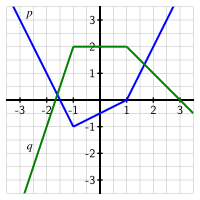
Let . Determine and . Let and . Determine and .
If a spherical tank of radius 4 feet has feet of water present in the tank, then the volume of water in the tank is given by the formula . At what instantaneous rate is the volume of water in the tank changing with respect to the height of the water at the instant ? What are the units on this quantity? Now suppose that the height of water in the tank is being regulated by an inflow and outflow (e.g., a faucet and a drain) so that the height of the water at time is given by the rule , where is measured in hours (and is still measured in feet). At what rate is the height of the water changing with respect to time at the instant ? Continuing under the assumptions in (b), at what instantaneous rate is the volume of water in the tank changing with respect to time at the instant ? What are the main differences between the rates found in (a) and (c)? Include a discussion of the relevant units.